
Customer Service Week provides a useful opportunity to focus on the people who interact directly with customers. But some of the most important Customer Experience problems are created much further inside the organization, often in areas where customers themselves are rarely visible.
A department improves its processing time. Another reduces cost. IT meets its availability target. The contact center achieves its service level. Complaints are closed within the required timeframe. On the management dashboard, everything may appear green.
The customer, however, may still experience delays, repeated requests for information, confusing handoffs, inconsistent messages, or unnecessary effort.
This is where organizations can sometimes confuse operational optimization with experience optimization. They are related, but they are not the same thing.
Organizations Work Vertically, Customers Experience Horizontally
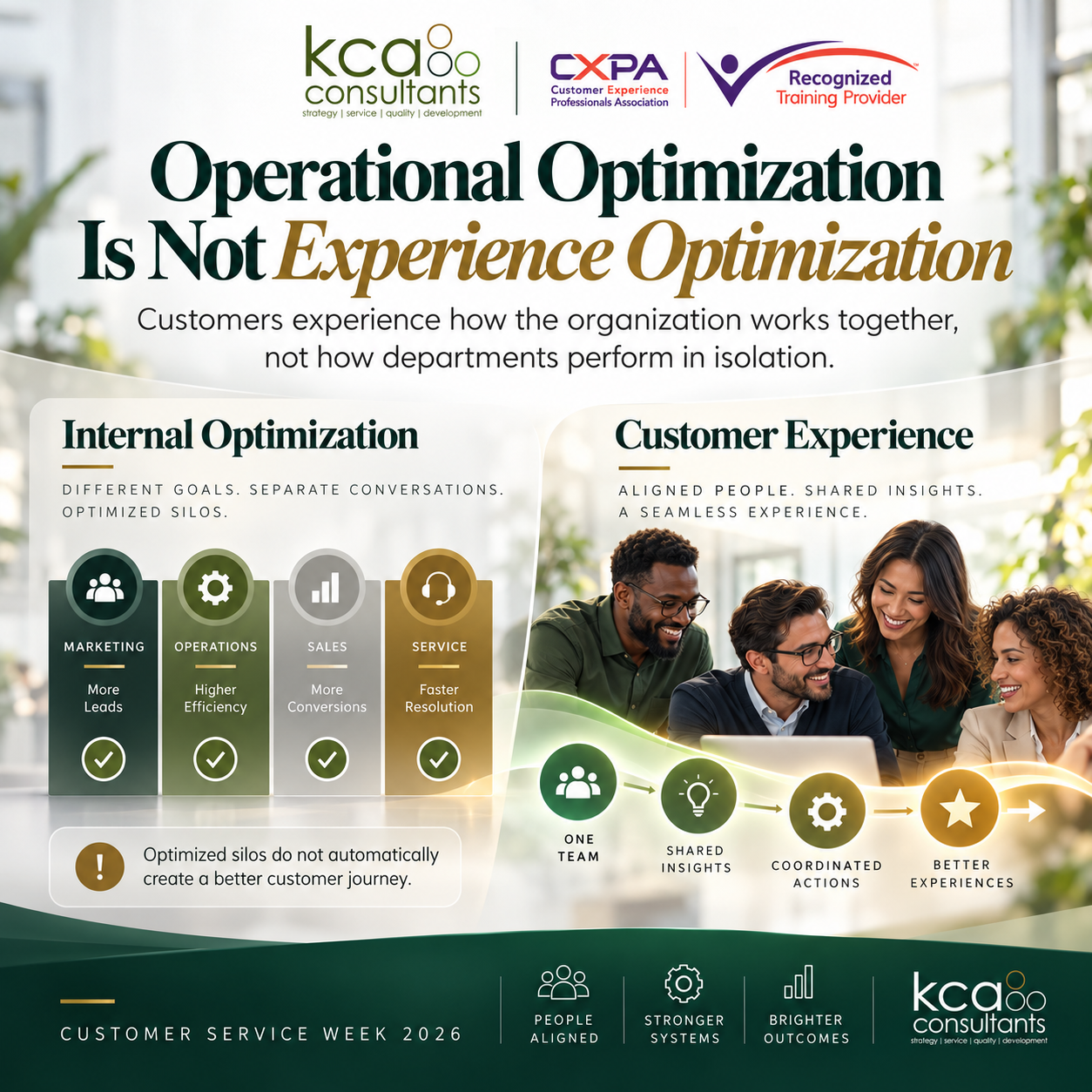
Organizations are usually structured vertically around departments, functions, budgets, responsibilities, and reporting lines. Customers experience them horizontally as one end-to-end journey.
Each team may therefore be doing exactly what it has been asked to do, while nobody is equally accountable for whether the complete experience actually works.
A process can become faster without making the overall journey faster. A contact center can answer calls quickly while customers continue calling about problems that should never have occurred. A complaints team can close cases within five days while the same root cause continues producing new complaints.
None of those KPIs are necessarily wrong. The problem arises when they are treated as evidence that the overall customer experience must also be working well.
When Green KPIs Still Produce a Poor Experience
One question that is often useful to ask is:
If every department involved in this journey achieved all of its targets, would the customer necessarily receive an excellent experience?
If the answer is no, then the organization has a gap between operational performance and experience performance.
That gap frequently exists between functions rather than within them.
Information may not move effectively between systems. Approvals may not have clear end-to-end ownership. Customers may be required to provide the same information more than once. Policies may make perfect sense internally while creating unnecessary effort externally. Each department can therefore perform well against its own measures while the customer still encounters friction across the overall experience.
Customers do not experience our organizational chart. They experience how effectively all its parts work together.
Optimizing the Parts Is Not Enough
This is why Customer Experience cannot be assessed only through departmental performance measures.
Internal KPIs remain important. Organizations need to manage productivity, cost, processing time, system availability, service levels, quality, and many other operational measures. But these measures need to be complemented by an understanding of what the customer actually experiences across the full journey.
Without that end-to-end perspective, organizations risk optimizing individual components while leaving the overall experience fragmented.
A collection of optimized departments does not automatically create an optimized customer journey.
Sometimes the biggest CX opportunity is not improving another individual process. It is improving how the different parts of the organization work together.
The Management Question
The more useful question is therefore not simply:
“Are our departments performing well?”
It is:
“Does the way our departments work together create the experience we intend to deliver?”
That difference matters.
Sustainable Customer Experience requires organizations to look beyond isolated functional performance and manage the connections between policies, processes, people, systems, decisions, and ownership.
Because customers do not experience our internal structures.
They experience the outcome those structures create.
This article forms part of KCA Consultants’ Customer Service Week and CX Day 2026 series exploring how organizations can move from individual service and CX initiatives toward more integrated Customer Experience Management.