
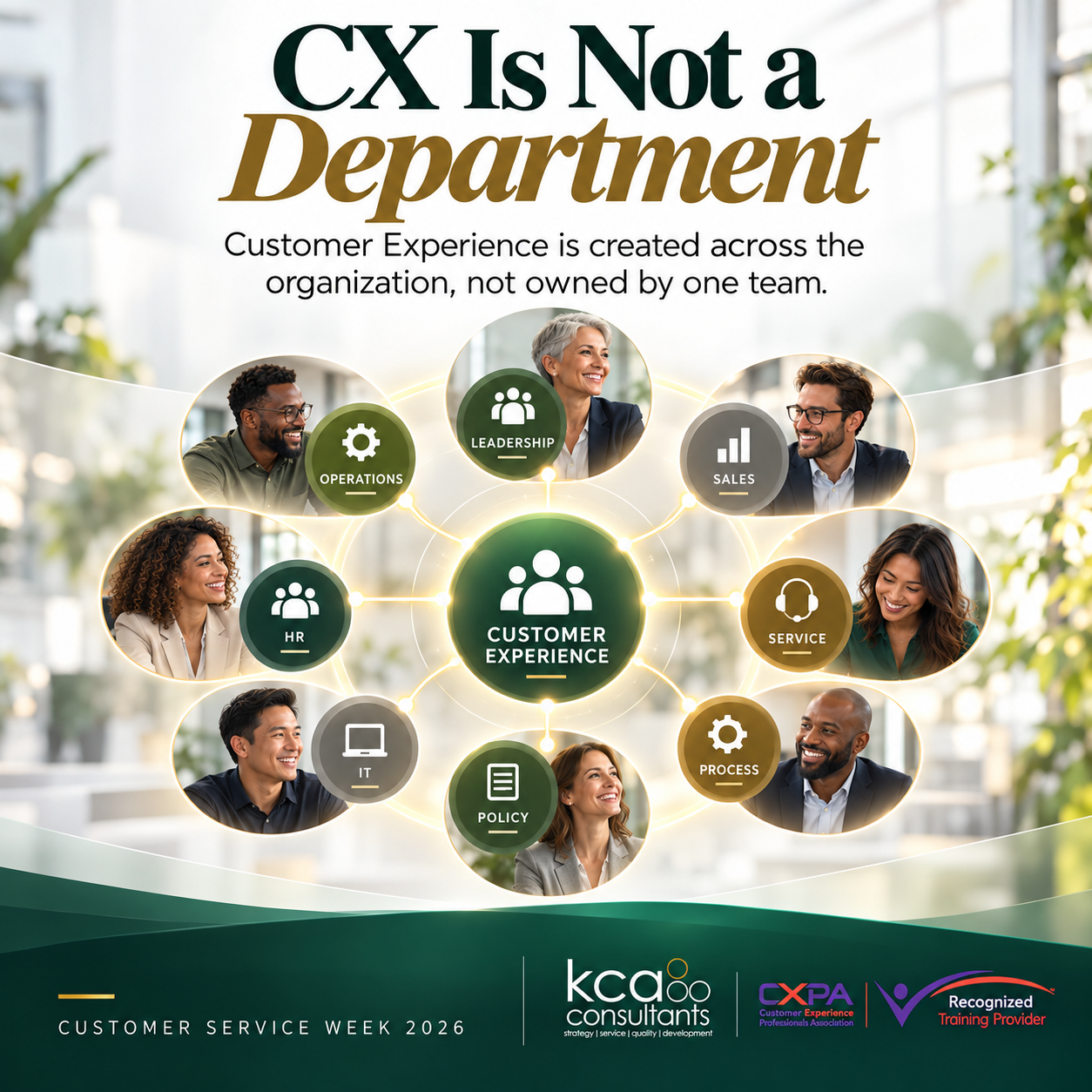

Over the past decade, many organizations have created Customer Experience teams, appointed CX leaders, introduced journey mapping, launched Voice of Customer programs, and added CX measures to management dashboards.
That is progress.
But there is also a risk that comes with formalizing CX: once a department has been given the name, the rest of the organization can start to assume that Customer Experience belongs to them.
It does not.
A CX team can provide direction, build frameworks, coordinate customer insight, facilitate journey improvements, challenge existing practices, and help management understand where the experience is breaking down. But it cannot, on its own, change a policy owned by another function, redesign a process it does not control, integrate systems managed by IT, change operational priorities, or compensate indefinitely for decisions made elsewhere.
A CX Team Cannot Own the Entire Experience
This is why some organizations end up with a strange contradiction.
They may have a dedicated CX department, sophisticated dashboards, journey maps, customer research, and perhaps even a formal CX strategy, yet customers continue to experience the same recurring problems.
The CX team sees the issues, but the authority, resources, systems, processes, and decision rights required to solve them sit elsewhere in the organization.
A CX function can identify that a particular policy creates unnecessary customer effort, but Policy may own the rule. It can identify repeated failures in a service journey, but Operations may own the process. It can highlight inconsistent digital and physical interactions, but IT and channel owners may control the systems involved.
This does not make the CX function ineffective. It demonstrates that Customer Experience is inherently cross-functional.
The Better Question Is How CX Is Managed
The real question is therefore not whether an organization has a CX department.
It is whether Customer Experience is embedded into how the organization is actually managed.
Are leaders accountable for end-to-end outcomes? Do process owners consider customer impact when making operational decisions? Are customer measures connected to performance management? Do Policy, Operations, IT, HR, Finance, Service, and other functions understand the role they play in shaping the experience?
These questions matter because the customer does not interact with an organizational chart. The customer experiences the combined effect of decisions made across multiple parts of the organization.
A policy decision can influence a service interaction. A technology constraint can increase customer effort. A performance target can unintentionally encourage behavior that improves one department while making the overall journey more difficult.
Customer Experience therefore needs to be considered wherever those decisions are made.
CX Needs Specialist Capability and Distributed Ownership
CX still requires specialist capability.
Organizations need people who understand Customer Experience strategy, journey management, customer insight, measurement, governance, service design, and improvement. A strong CX function can provide methodology, coordination, challenge, expertise, and a common view of what customers are experiencing across the organization.
But specialist capability should not become a substitute for organizational ownership.
The CX function should help create the management system, connect insight across the organization, build capability, facilitate improvement, and challenge existing practices where necessary.
The experience itself, however, is created every day through thousands of decisions made across the business.
That requires distributed ownership supported by clear governance.
A Simple Test of CX Maturity
One useful question is:
If the CX department disappeared tomorrow, would the rest of the organization still make decisions with the customer in mind?
Would leaders still review customer outcomes? Would process owners still consider customer effort? Would IT still evaluate the experience implications of system decisions? Would Policy still challenge unnecessary requirements? Would operational teams still investigate recurring customer problems?
If the answer is no, then CX has probably not yet become part of the organization.
It is still sitting beside it.
A mature Customer Experience organization should not depend entirely on the CX team to remind everyone else that the customer matters.
The role of CX should increasingly be to enable, coordinate, govern, challenge, and strengthen the organization’s ability to manage Customer Experience, rather than becoming the place where all responsibility for the customer is deposited.
Customer Experience should not belong to one department.
It should be reflected in how the entire organization thinks, decides, measures, prioritizes, and improves.
This article forms part of KCA Consultants’ Customer Service Week and CX Day 2026 series exploring how organizations can move from individual service and CX initiatives toward more integrated Customer Experience Management.